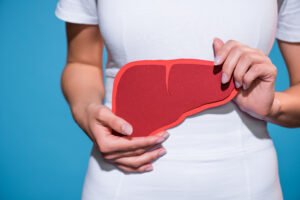
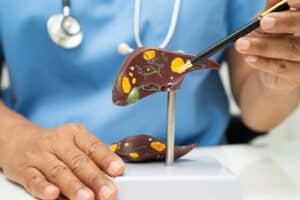
Fatty liver disease is one of the most common health problems in the UK, yet many people who have it do not know. Up to 1 in 5 people in the UK are thought to be living with it. The reason so many cases go unnoticed is simple. In the early stages, fatty liver disease usually causes no clear symptoms at all.
Your liver is a quiet organ. It does hundreds of jobs, from cleaning your blood to storing energy, and it keeps doing them even when it is under strain. That means the first signs are often so mild that people put them down to a busy week, poor sleep or getting older.
This guide explains the signs that are easy to miss, the ones that need a GP appointment, and what you can do next.
What is fatty liver disease?
Fatty liver disease happens when too much fat builds up inside the liver. It is now usually called MASLD, which stands for metabolic dysfunction-associated steatotic liver disease. You may also see the older name, NAFLD, which stands for non-alcoholic fatty liver disease.
A small amount of fat in the liver is normal. The problem starts when fat makes up more than about 5 to 10 per cent of the liver’s weight. Over time, that extra fat can cause swelling and scarring.
If you want the full background on how the two names fit together, our guide to what MASLD and NAFLD actually mean breaks it down in plain terms.
Why the symptoms are so easy to miss
Most people expect a health problem to hurt. Fatty liver disease often does not. There are three reasons the early signs slip past:
- The liver has no pain nerves inside it. You only feel discomfort when the liver swells enough to press on the tissue around it.
- The liver keeps working. Even a liver with a lot of fat in it can carry on doing its job for years.
- The symptoms are vague. Tiredness and feeling a bit run down could be caused by dozens of everyday things.
This is why fatty liver disease is very often found by accident, during a blood test or a scan done for something else entirely.
The early signs most people miss
These are the quiet signs. On their own, none of them proves anything. Together, and especially if you have any of the risk factors further down this page, they are worth mentioning to your GP.
| Sign | What it feels like | Why it is often ignored |
| Ongoing tiredness | Feeling drained even after a full night’s sleep | Blamed on work, stress or poor sleep |
| Dull ache on the upper right side | A heavy or full feeling under the right ribs | Mistaken for indigestion or a pulled muscle |
| Feeling generally unwell | A low, “not quite right” feeling that hangs around | Put down to a virus that never fully cleared |
| Trouble concentrating | Foggy thinking, losing your thread mid-sentence | Blamed on age or a busy mind |
| Unexplained weight loss | Losing weight without trying | Often welcomed rather than questioned |
| Weakness | Everyday tasks feel harder than they used to | Blamed on being out of shape |
| Loss of appetite | Meals feel like an effort | Put down to a change in routine |
Tiredness is by far the most common of these, and by far the most ignored. If you have felt unusually worn out for months rather than weeks, it is worth raising.
The long-term signs that need a GP appointment
If fatty liver disease moves on to the scarring stages, the signs become much clearer. Book a GP appointment if you notice any of the following:
- Yellowing of the skin or the whites of the eyes
- Swelling in the tummy, ankles or legs
- Itchy skin with no rash
- Very dark urine or pale stools
- Bruising more easily than usual
- Feeling sick or being sick regularly
- Confusion or unusual sleepiness
These signs do not always mean liver disease, but they should always be checked.
How the stages work
Fatty liver disease is usually described in four stages. Most people never move past the first one, especially if they make changes early.
| Stage | Name | What is happening |
| 1 | Simple fatty liver (steatosis) | Fat has built up in the liver, but there is no damage. Usually harmless and often has no symptoms. |
| 2 | MASH (inflammation) | The fat has caused the liver to become inflamed and irritated. |
| 3 | Fibrosis | Lasting scarring has formed, but the healthy parts of the liver still work well. |
| 4 | Cirrhosis | Widespread scarring. The liver struggles to work properly. This stage is serious. |
The NHS explains these stages and how they are diagnosed in more detail on its non-alcoholic fatty liver disease page.
The good news is that the earlier stages can often be improved. Our article on whether a fatty liver can go back to normal covers what the evidence says about diet, activity and weight.
Who is most at risk?
You are more likely to develop fatty liver disease if you:
- Are living with type 2 diabetes or insulin resistance
- Carry extra weight, particularly around the middle
- Have high blood pressure
- Have high cholesterol or high triglycerides
- Are not very active day to day
- Eat a lot of sugary or heavily processed food
- Are over 50
- Have an underactive thyroid
Having one of these does not mean you will get fatty liver disease. It does mean the quiet symptoms above deserve more attention.
Symptoms can look different in women
Fatty liver disease does not affect everyone in the same way. Hormones, menopause, and conditions such as polycystic ovary syndrome can all change how the condition develops and how it feels. Women are also more likely to have their tiredness put down to something else.
We cover this in full in our companion article on how fatty liver symptoms differ in women and why that happens.
How fatty liver disease is diagnosed
There is no single test. A GP will usually start with:
- Blood tests. These check the levels of liver enzymes. Raised levels suggest the liver is under strain.
- An ultrasound scan. This is painless and can show fat sitting in the liver.
- A FibroScan. This is a special scan that measures how stiff the liver is. Stiffer liver tissue can mean scarring.
Blood tests alone are not perfect. Some people with fatty liver disease have completely normal liver blood results, which is another reason cases are missed.
What you can do next
If you recognise several of the signs on this page, or you have one or more of the risk factors, book a GP appointment and ask directly about your liver. Say what you have noticed and how long it has been going on.
Alongside that, there is another route worth knowing about. There is currently no licensed medicine in the UK made specifically for fatty liver disease, which is why research matters so much. Clinical trials are how new treatments are tested and approved.
Taking part in a trial also means regular health checks, liver scans and blood tests, plus time with clinical staff who are focused on your liver. For many participants, that level of monitoring is valuable in itself.
You can read more about what happens at your first appointment before you decide anything.