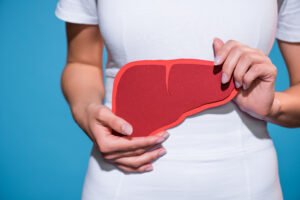
Every year on 25 September, World Pharmacist Day celebrates the work pharmacists do to keep people safe and well. Most of us think of a pharmacist as the person who hands over a prescription. In reality, they do far more than that. One of their most important jobs is keeping an eye on how the medicines you take affect your body, including your liver.
This matters more than people realise. When it comes to your liver, it processes almost every medicine that enters your body, which means it can end up carrying a lot of the workload. For most people, this causes no problems at all. But if you already live with fatty liver disease, a medicines review with your pharmacist becomes an even more useful check-in.
This article explains why that review matters, what it involves, and how it connects to our current fatty liver disease clinical trial.
A quick reminder: what fatty liver disease is
Your liver is meant to hold a small amount of fat. Fatty liver disease happens when too much fat builds up inside it instead.
Doctors now usually call this MASLD, short for metabolic dysfunction-associated steatotic liver disease. You might still see the older name, NAFLD, used too. If you want the full picture, our guide to what MASLD and NAFLD actually mean explains it simply.
Fatty liver disease is closely linked to type 2 diabetes, high blood pressure, high cholesterol and being overweight. It often causes no symptoms at all in its early stages, which is part of why regular checks, including medicines reviews, are so useful.
Why your liver matters when it comes to medicines
Think of your liver as a filter. Most medicines pass through it to be broken down, so the body can use what it needs and get rid of the rest. This is normal and happens every single day, for everyone.
The issue is that a liver already under strain from extra fat does not always process medicines in quite the same way as a healthy liver. Some medicines may need to be used more carefully, some doses may need adjusting, and some combinations of medicines are worth a closer look. This is not about any medicine being dangerous on its own. It is about making sure each medicine is right for your liver, at the dose that suits you.
Certain herbal remedies and supplements can also affect the liver, even though they are natural. This is another reason it helps to mention everything you take, not just prescription medicines, when you see your pharmacist.
We are not going to name specific medicines here, because the right choice always depends on your own health history. That decision belongs to you and your pharmacist or doctor. What we can tell you is why the conversation is worth having.
What is a pharmacist medicines review?
A pharmacist medicines review is simply a conversation about everything you take, prescription medicines, over-the-counter remedies, vitamins and herbal supplements included. Many pharmacies offer this as a free service, and you do not usually need a GP referral to ask for one.
During the review, a pharmacist will typically:
- Go through every medicine and supplement you currently take
- Check for any medicines that might interact with each other
- Ask how you are getting on with each medicine, including any side effects
- Flag anything worth discussing further with your GP
- Answer any questions you have about timing, doses or what a medicine is for
It is a good moment to be honest about anything you take that a doctor might not know about, including supplements bought online or remedies a friend recommended.
Why this matters more if you have a linked health condition
Fatty liver disease rarely travels alone. It is closely connected to other conditions, and having more than one at once can mean more medicines to keep track of.
| If you have | Why a medicines review helps |
| Fatty liver disease and type 2 diabetes | Diabetes medicines are often adjusted alongside liver health, since the two conditions share common causes |
| Fatty liver disease and high blood pressure | Blood pressure medicines are usually processed by the liver, so a review checks that everything fits together well |
| Fatty liver disease and high cholesterol | Cholesterol medicines can sometimes need monitoring alongside liver health |
| Several medicines from different prescribers | A pharmacist can see the full list in one place, which a single doctor might not always have |
If you want to understand the connection between two of the most common linked conditions, our article on how fatty liver disease and type 2 diabetes are linked explains why the two so often appear together.
What to ask your pharmacist
You do not need a script, but these questions are a useful starting point:
- Could any of my current medicines affect my liver?
- Am I taking anything that might interact with something else on my list?
- Is there anything I should tell my GP about before my next appointment?
- Are there any supplements or herbal remedies I should be cautious with?
A good pharmacist will welcome these questions. Asking them does not mean something is wrong. It means you are keeping on top of your own health, which is exactly what World Pharmacist Day is about.
For a trusted, independent explanation of how medicines can occasionally affect the liver, the British Liver Trust’s guide to drug-induced liver injury is a helpful, plain-English resource.
Could a clinical trial be the next step?
If you already have a diagnosis of fatty liver disease, and you also live with a linked condition such as type 2 diabetes, high blood pressure or high cholesterol, you may be able to take part in our fatty liver disease clinical trial.
At 4MCS, we run ethically approved research into fatty liver disease, following strict safety guidelines set by the MHRA. Every participant is given clear information before agreeing to take part, and no one is ever pressured to join. If you would like to understand exactly what that process looks like, our guide on understanding your rights as a participant explains it step by step.
Taking part usually involves regular appointments, which can include blood tests, physical checks and liver scans, alongside support from our research team throughout. It is a way to access closer monitoring of your liver health while also helping researchers learn more about a condition that affects a huge number of people across the UK.
You can find out more by visiting our fatty liver disease clinical trial page.
Find a clinic near you
We run clinical trials from two clinics in the UK, both currently recruiting participants.
- London: our Ilford clinic in East London is a short walk from Ilford railway station and served by several bus routes.
- Manchester: our Swinton clinic sits in M60 Office Park with free parking on site, about ten minutes from Swinton train station.
You can find full details, including addresses and directions, on our clinics in London and Manchester page.
To see every study currently recruiting, including our fatty liver disease trial, visit our current clinical trials page.
Call us free on 03300 575 838, email volunteer@4mcs.co.uk, or register your interest online.